
'China any day would prefer to team up with India and dump Pakistan once the resolution of the border dispute becomes an accomplished fact.'

'One lesson to emerge out of the Modi-Putin summit is that India can be more self-confident that it possesses inherent strengths to leverage its interlocutors to influence Pakistani policies,' says Ambassador M K Bhadrakumar.

Indians at large harbour a notion that their country is cherrypicking out of the American basket of goodies, but the policymakers in Delhi and the political leadership are well aware that it can only be a pipe dream since a military alliance with a superpower is a profound irrevocable commitment, observes Ambassador M K Bhadrakumar.
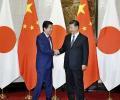
'Both Japan and China face a common challenge: How to deal with Trump.' 'The trade war with the US seems to have facilitated/hastened Abe's China visit, the first by a Japanese prime minister since 2011,' points out Dr Rajaram Panda.

'Macro headwinds are rising for Indian equities in the form of rising commodity prices, especially oil, depreciating rupee, fiscal challenges, election-related uncertainty and upside risks to inflation'
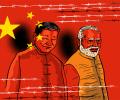
'An opportunity is at hand to think big and recast the India-China relationship on a new template, which would help the pursuit of our country's dream of major power status,' says Ambassador M K Bhadrakumar.
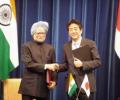
India's commitment to an open and plural security architecture attests to the fact that Asia's transition is a dynamic of both power & identity, says Zorawar Daulet Singh

Average global growth prospects for the next 12 months and the next three years are 35 per cent and 49 per cent, respectively.

The United States has ruled out any mediation on the Kashmir issue as long as India rejects such a proposal and asked Pakistan to avoid employing militancy as an instrument of state policy.

Even as the United States snuggles closer to India with the thinly veiled objective of containing China, the Indian strategy is to avoid alienating either nation.

There are many reasons for Japan to turn a deaf ear to its anti-nuclear lobby and concentrate on its geo-strategic imperatives to sign the nuclear deal with India, says Debalina Ghoshal.

How will the Modi Sarkar's likely return affect other nations?

'After many rudderless years, India and Japan have prime ministers with a sense of purpose and direction,' says Brahma Chellaney.

China is on the lookout for investment pastures where its money is welcome, safe and earns a decent return. India also needs vast investment - about $1 trillion over the next 10-15 years - in infrastructure, green energy, transportation and heavy industry, says Ravi Bhoothalingam.

The perfunctory management of external affairs has left India's foreign policy establishment largely unprepared to manage the consequences of dramatic international developments, says Nitin Pai.
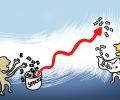
While enjoying long-awaited economic good times - and hoping they will last as long as possible - some caution and some prudence might be the best protection against bad surprises, says Claude Smadja.
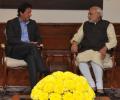
Should India engage Pakistan's generals directly, bypassing Imran? Ambassador G Parthasarathy, India's former high commissioner to Pakistan, ponders Delhi's diplomatic dilemma.

'This is the first time that the Americans have agreed to refer to "cross-border terrorist attacks" in a joint statement.' 'No wonder Pakistan has called the joint statement "singularly unhelpful" and has blasted it, and its all-weather friend China has applauded Pakistan's frontline role in combating terrorism,' points out former foreign secretary Ambassador Kanwal Sibal.

US India Business Council has urged New Delhi and America to take steps to strengthen bilateral trade relationship to realise their 'true business potential'.
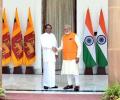
In the aftermath of the Easter Sunday terrorist attacks, allegations have been made that the Muslim militants in Sri Lanka draw sustenance from India. An overarching impression is being created that the ISIS is gaining ground in India, points out Ambassador M K Bhadrakumar.

However, it still lags far behind the US, which leads with a market-capitalisation of $23.9 trillion through August 2014.

The summit at Sentosa -- the first between the two countries -- is a turnaround of relations between the US president, 71, and the North Korean leader, 34, after a long-running exchange of threats and insults.

'The path to a resolution of the ethnic conflict is likely to be complicated and controversial with the majority Sinhalese community, and will become less likely if delayed.' 'It will certainly give Rajapaksa fresh political oxygen with which to revive himself and rally the opposition.'

New Delhi and Beijing are the only two regional capitals that have commented on US President Donald Trump's speech on August 21 outlining the way forward in Afghanistan. The Indian foreign ministry statement was effusive in praise, while the Chinese statement has been one of cautious and guarded hope. Delhi has identified itself with Trump's Afghan strategy, whereas the Chinese stance is calibrated -- observant and objective, keeping a distance, says Ambassador M K Bhadrakumar.

We present our alphabet of 2020, pulling in everything you'll remember about this year we'd rather forget.
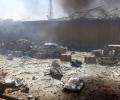
'A couple of more such happenings in the coming weeks can push Kabul into total anarchy, and a Syria-like conflict may ensue,' warns Ambassador M K Bhadrakumar.

'Over the last two decades, the India-French relationship has grown steadily, no major political difference having darkened the sky between Paris and Delhi,' says Claude Arpi.

Tillerson is a veteran chief executive who has had extensive overseas business dealings but his relationships with foreign leaders could complicate his confirmation prospects.
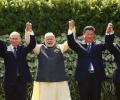
Narendra Modi's success at the BRICS summit is the best Diwali gift for India's diplomacy and marks her ascendancy to global leadership, says Tarun Vijay.

'The defence minister needs to focus on human resources-related issues at the same pace in 2017 as he did on acquisitions in 2016,' says Brigadier S K Chatterji (retd).
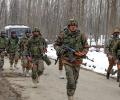
'A couple of Pulwamas will bring the two nations to war and it will be limited to J&K itself.'

Can Modi and Obama forge a common outlook on international terrorism?

The two countries sealed 10 agreements, including the much-publicised transit trade treaty which will end Nepal's total dependency on Indian sea ports for third-country trade.

'Modi's recent decisions to improve India-China relations, adjust India's neighbourhood policies and to rebalance India's ties with the major powers are linked to his political agenda.' 'Of course, the good part is that this agenda is also in the national interest,' says Ambassador M K Bhadrakumar.
The government told the apex court that the decision whether or not to allow refugees to settle in the country was best left to the Executive.

The implications of the interim deal between Iran and the world's big powers go far beyond the nuclear programme, says Nitin Pai

'If Myanmar falls to China, let it.' 'Sooner or later the rulers of the country will have to call New Delhi.'
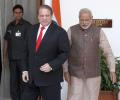
'Instead of isolation, India should respond militarily to every act of terrorism assessed to have come from across the border, unilaterally declare Pakistan a State that supports terrorism and cease all economic dealings with it.'

The government has to take a call on reducing or retaining the excise rate.
'There is nothing that Pakistan has done which deserves a resumption of dialogue. The assurances made in Ufa contain no commitment except a whole range of talks, which could take place without the paraphernalia associated with a joint statement of prime ministers.'
